PR-Cage: Progressive Feasibility Relaxation for Tight Bounding Cage Generation

1Shandong University 2Hangzhou Dianzi University 3Shandong Huayun Technology Co., Ltd. 4HoteamSoft 5Qingdao University of Science and Technology 6Texas A&M University 7University of Health and Rehabilitation Sciences 8Shandong Key Laboratory of Deep Sea Equipment Intelligent Networking
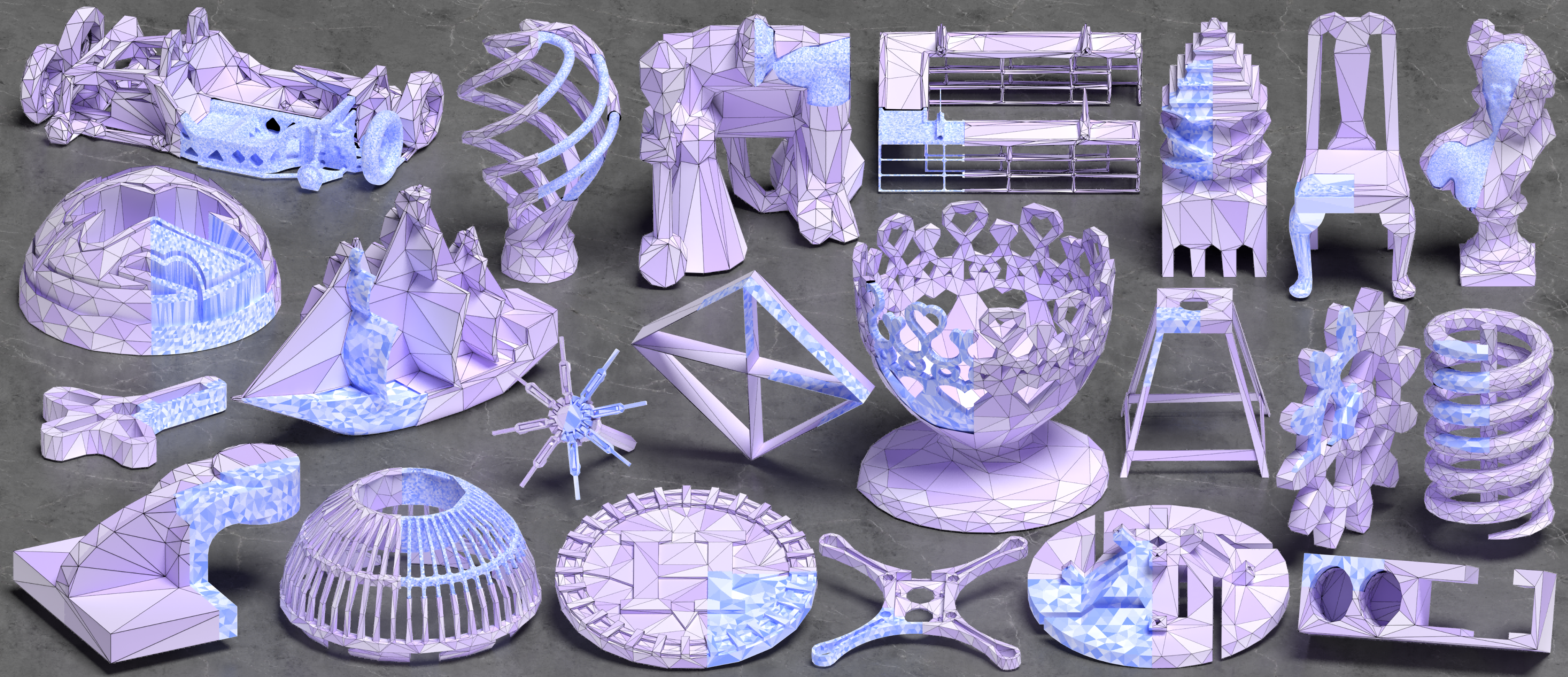
Gallery of cages generated by PR-Cage on representative models from Thingi10K and ABC

PR-Cage consistently produces compact, tightly adhering cages on diverse geometric shapes, including thin plates, tubular structures, and models with high topological complexity.

Abstract

Cages are fundamental structures in computer graphics, serving as versatile proxies for deformation, simulation, collision handling, neural parameterization, and multiresolution geometry abstraction. A high-quality cage must balance two competing objectives: minimizing face count for simplicity while maximizing tightness to maintain high geometric fidelity to the input mesh.

PR-Cage introduces a nested optimization framework for automated cage generation. The outer control layer uses a thickness parameter τ to define a feasibility region guided by the τ-offset surface, and progressively relaxes this parameter through a staircase schedule. The inner optimization extends the classical Quadric Error Metric framework with rigorous linear inequality constraints that suppress triangle degeneration and prevent normal flips. The algorithm relies only on edge collapses and edge flips, yielding efficient and robust cage generation.

Method Overview

Given a closed, oriented, manifold, self-intersection-free triangle mesh, PR-Cage greedily simplifies it into a lower-complexity bounding cage while maintaining geometric and topological validity.

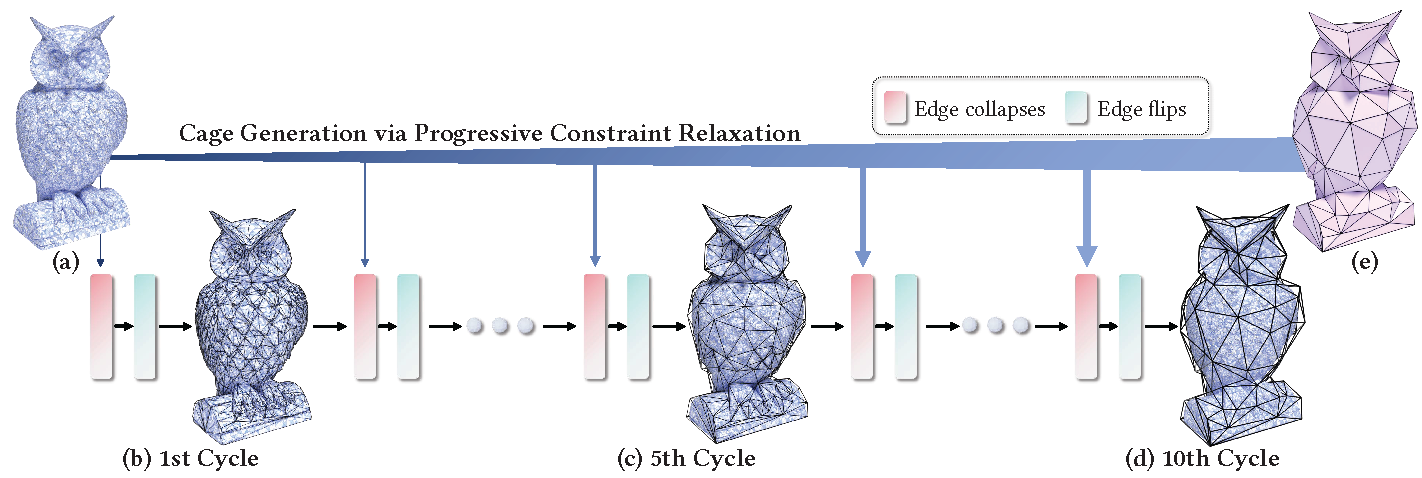
PR-Cage pipeline: constrained edge collapses and edge flips under progressive constraint relaxation
Pipeline: constrained edge collapses and edge flips progressively simplify the cage as the thickness parameter is relaxed.
  • 1
    τ-controlled enclosure. Candidate updates are restricted to a local slab between the input surface and its outward offset, preserving feature adherence while allowing simplification.
  • 2
    Orientation constraints. Linear half-space constraints keep updated faces aligned with their original orientation and suppress foldovers.
  • 3
    Active-set QP solver. Each collapse solves a compact three-variable quadratic program with a small set of linear inequalities.
  • 4
    Edge-flip refinement. A post-decimation flipping stage improves triangle quality while preserving face count and validity.

Large-scale Evaluation

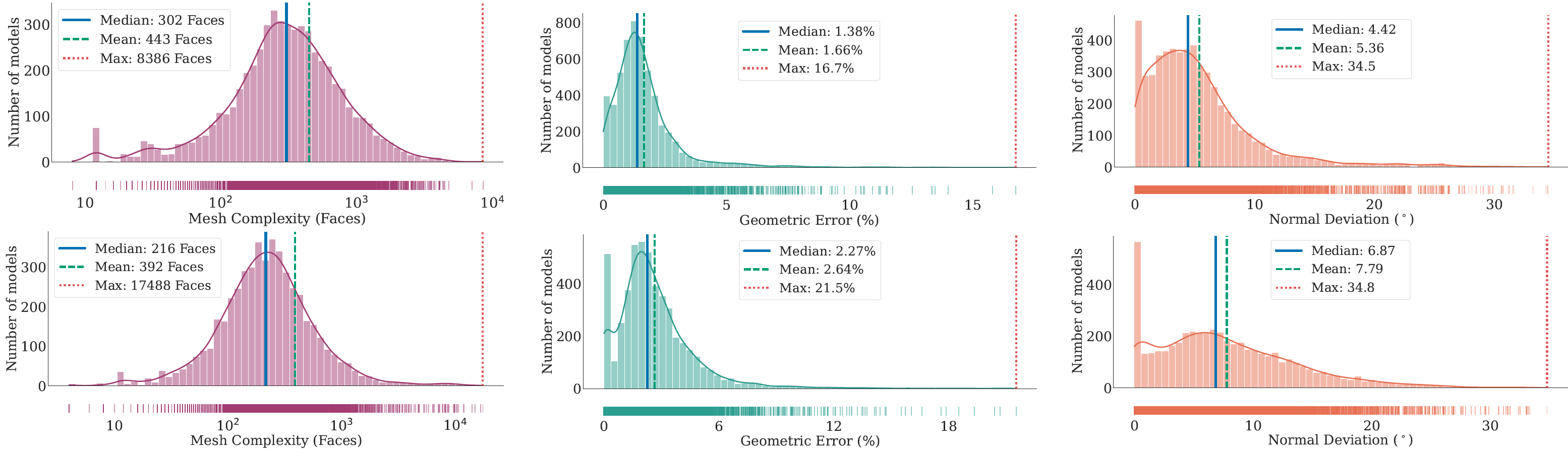
The method is evaluated on 5,046 Thingi10K models and 5,508 ABC models, covering real-world meshes, CAD-like shapes, thin structures, sharp features, and high topological complexity.

Quantitative distributions on ABC and Thingi10K benchmarks
Quantitative distributions on ABC and Thingi10K: PR-Cage maintains low mesh complexity while achieving low geometric and normal-deviation errors.

Comparison with Existing Cage Methods

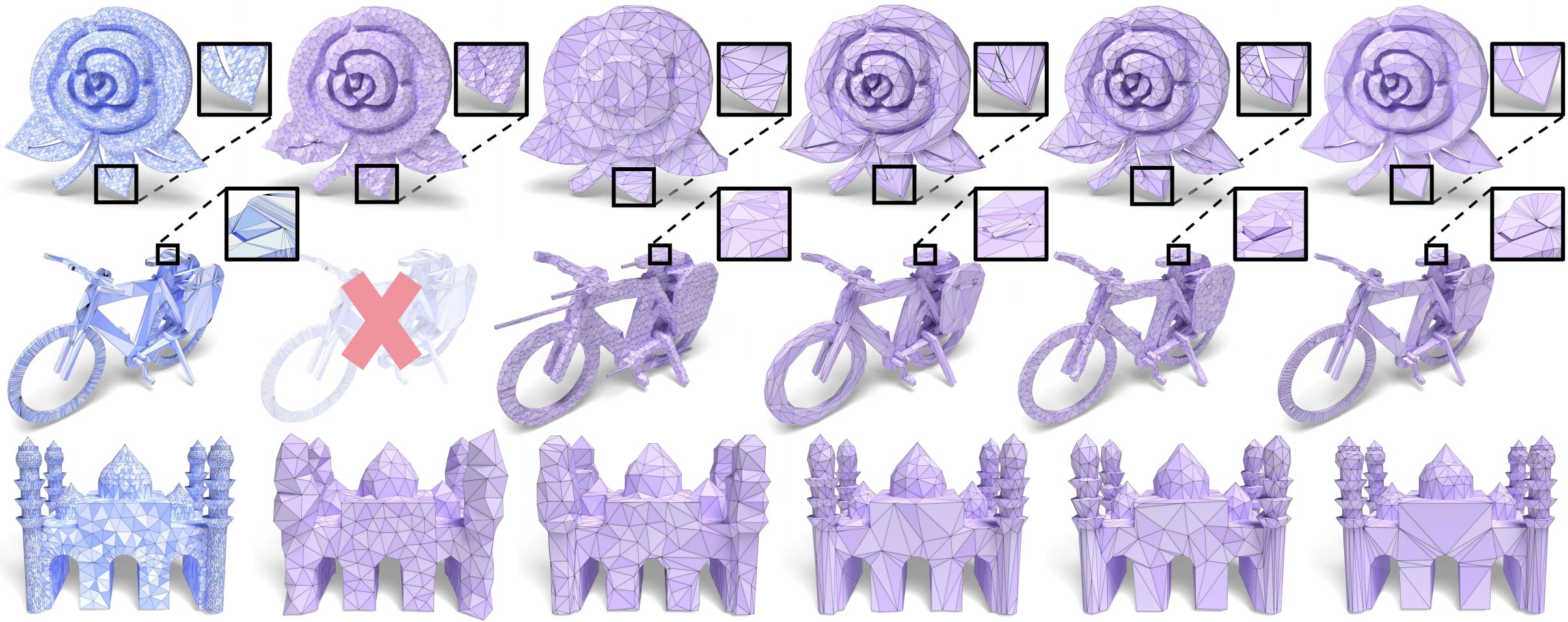
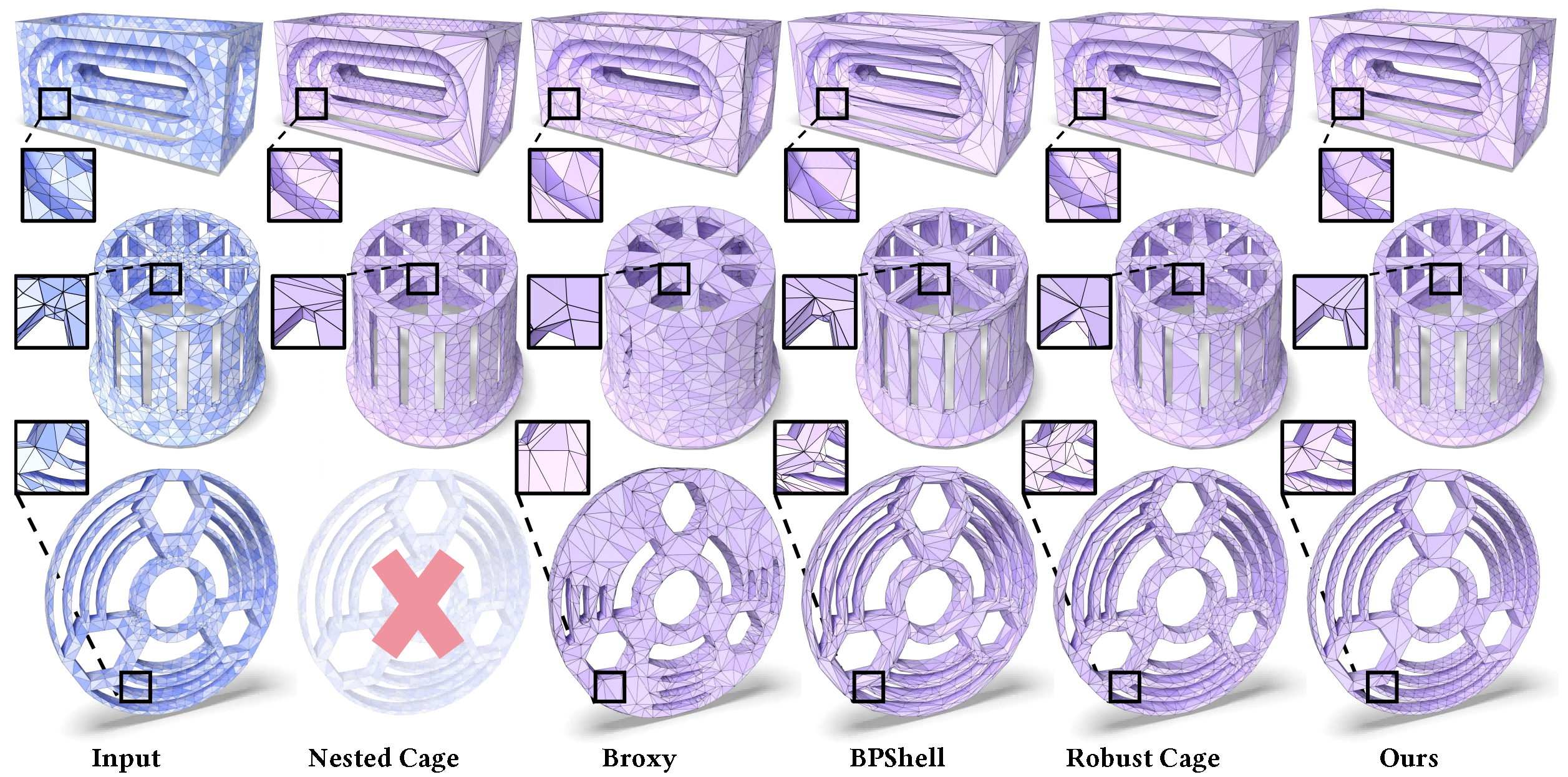
Compared with Nested Cage, Broxy, BPShell, and Robust Cage, PR-Cage targets the simultaneous requirements of low triangle count, strict enclosure, manifoldness, watertightness, absence of self-intersections, and high surface adherence.

Comparison with Nested Cage, Broxy, BPShell, Robust Cage, and PR-Cage Comparison with Nested Cage, Broxy, BPShell, Robust Cage, and PR-Cage
Representative comparison: PR-Cage obtains the lowest triangle count among the compared cage results while improving Hausdorff distance and normal deviation.

Applications

Contact-rich cloth simulation

Strictly enclosing, tightly fitted cages preserve support at sharp features and reduce contact complexity while maintaining stable cloth interactions.

Cloth simulation: PR-Cage preserves stable contact where other proxies slide or collapse.

Rigid-body simulation proxies

High-quality cages provide low-complexity collision proxies for simulations where geometric support and contact normals are critical.

Rigid-body simulation: cages serve as efficient proxies for contact-rich dynamics.

Constrained mesh simplification

The progressive relaxation strategy can also be extended to high-fidelity constrained simplification by controlling the feasible region around the input surface.

Constrained simplification: the same feasibility relaxation principle enables compact geometry while preserving fidelity.

Low Poly

PR-Cage generates compact, low-poly cage representations that preserve the major geometric structures of the input mesh while significantly reducing triangle count.

Low Poly: PR-Cage produces simplified yet shape-preserving proxy meshes with clean geometric structure.

BibTeX

@article{wen2026prcage,
  title   = {PR-Cage: Progressive Feasibility Relaxation for Tight Bounding Cage Generation},
  author  = {Wen, Huibiao and Qin, Kaikai and Su, Xinxin and Mei, Jingcheng and Chen, Shuangmin and Deng, Chongyang and Tu, Changhe and Xin, Shiqing and Wang, Wenping},
  journal = {ACM Transactions on Graphics},
  volume  = {45},
  number  = {4},
  article = {149},
  year    = {2026},
  month   = {August},
  pages   = {16}
}